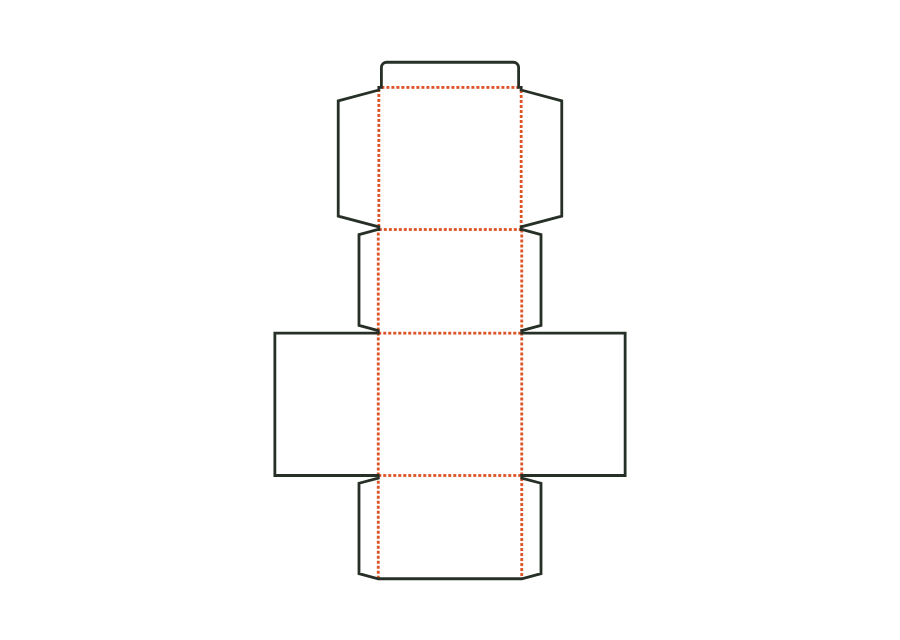
Rollover width
Width of the double wall's rollover (crease-to-crease); holds the flaps in the pocket.
 JetDieline
Food and hospitality / JETDIELINE
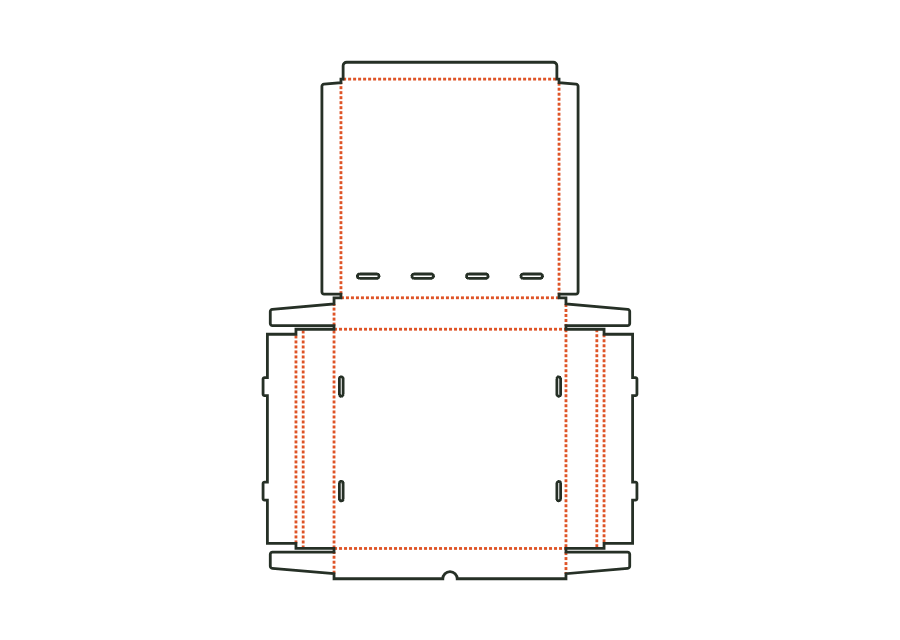
The pizza box is made from one blank with double side walls, interlocking corners and a hinged lid. Inside dimensions determine the space for the pizza; ventilation slots and locking tabs are separate parameters.
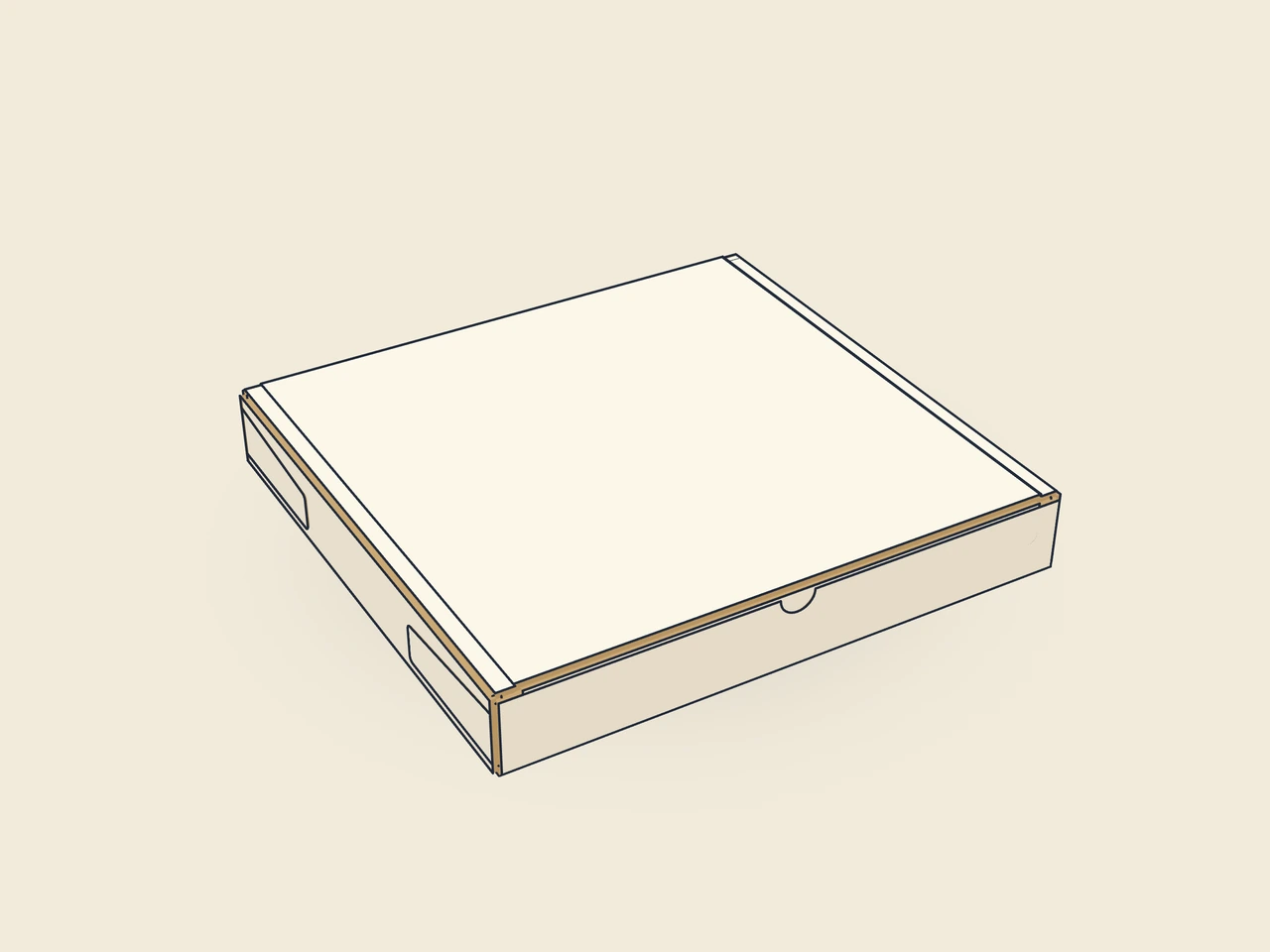
Drag to rotate
03 / BOX
Simplified display model without material thickness, not to scale.
The 3D view is not available in this browser. The image shows the folded shape.
carton.pizzaFront and back walls carry ears that sit in the double side wall pockets. Turnovers with tabs engage in bottom slots. The back wall is followed by lid, lid dust flaps and tuck flap. A row of oblong holes runs parallel to the lid hinge.
Erect the front and back walls and fold the ears inwards. Erect the side walls, fold the turnover inwards over the ears and press the tabs into the bottom slots. Insert the pizza, fold in the lid dust flaps, close the lid and insert the tuck flap behind the front wall.
Flute direction parallel to blank height as with the mailer: side wall and turnover creases lengthwise, lid hinge across the flute; the large lid deflects less (check with the corrugated board printer).
Test fit, folding and closure on a sample made from the intended material. Confirm material thickness, grain direction and production steps with your printer.
Compare openings and closures for your food product. Check direct-contact material, moisture and grease resistance with the manufacturer.
Inside dimension
These dimensions describe the preview, not a fixed packaging size. The app recalculates the dieline for your own dimensions.
Width of the double wall's rollover (crease-to-crease); holds the flaps in the pocket.
Gap between adjacent flaps or walls; at least about the material thickness.
Length of the ears or corner flaps as a proportion of half the inside width.
Length of the lid dust flaps as a proportion of the inside height.
Angle of the dust flaps (also the ears on a mailer); larger angles prevent collisions during folding.
The example uses inside dimension 300 × 300 × 40 mm. The designation 30 cm does not replace measuring the topped pizza and required clearance. Check height, rim and insertion on the sample. The catalogue also lists 260, 330 and 400 mm as starting sizes; each size is recalculated rather than scaled.
The construction is erected without glue. Ears sit between the double side walls and tabs engage in bottom slots. The starting run therefore lists no glue area. This works only with suitable pocket clearance and locking in the target material. Check on the sample whether the turnovers stay in their intended positions during filling and opening.
Yes, vents switches ventilation in the lid. With ventilation enabled, count, length, width and distance from the hinge determine the row of oblong holes. Constraints limit their extent and preserve bridges. The geometry does not simulate steam transport; assess the effect on the packaged pizza with actual filling and transport duration.
Find the right packaging shape and fit it to your product
Design the artwork directly on the real dieline
Spot problems before you pass on files
Files your printer can trace
Calculate the conical wall of a paperboard cup from rim diameter, base diameter and finished height. The annular sector includes the glue seam and separate allowances for the bottom curl and top rolled rim.
cone.cup.wrapView templateThe clamshell tray combines a base with glued corners and a lid hinged to the back wall. You choose a tuck flap or tab-and-slot closure and calculate either from inside or outside dimensions.
carton.tray.hingedView templateThe takeout box has outward-sloping front and back walls, glued corners and a folding lid with tuck flap. Inside width and outside width have different reference points.
carton.takeoutView templateThe cup sleeve is an annular sector with a glue flap for an existing tapered cup. You measure the diameters at the top and bottom edges of the sleeve and its vertical height.
sleeve.cupView templateWith JetDieline, choose a suitable template, adjust its size, and place text, logos, and images directly on your packaging.
Try your dimensions Download on the Mac App Store